Hand and Eye briefing
The brief for this project is focusing on creating a character inspired by the book ”Frankenstein” by Mark Shelley. His belief were beyond the reality and risked nature. This means it is important to be experimental, to invent something extraordinary like Frankenstine. The first workshop will allow me to develop a character using experimental drawing. I will learn about colour and storytelling. I will be asked to use my character as a protagonist in a storyboard led by lyrics to a song, and will develop a story throughout using print and three spot colours.
My outcome for this project will be a nine frame storyboard that illustrates a song using constructed figurative character from the first phase of the project.
The aim of this project will be to look a figurative drawing in different perspectives, gain knowlegede of collage, learn about colour theory, learn about narrative and storytelling.
First workshop: 11/02/19
Our first task was to collaborate with our partner and use 2 A2 sheets of paper stick them together and draw around our body of our partner, and they did the same for us. After drawing around our bodies we were asked to explore our fears and what we are afraid and use this to illustrate these feelings and imagery inside our outlined bodies. Almost creating a monster with our fears.
I have found this task to be very interesting because it allowed me to explore my inner fears. For some parts it was interesting to see how my fears became to be within life spectrum like the idea of someone close dying, having a broken heart, fear of staying alone. Other fears were rats/Mouses, feeling sad, stress and the idea of performing on a stage. As well as exploring myself, I was able to see other people’s fears and see how different they are from mine. Some people wanted to keep private about their fears maybe they were to afraid to talk about them! or maybe it was very personal.
I feel like my illustration was very rushed and wasn’t very well thought before putting it on the paper. I only had colourful markers to work with so it wasn’t what I’ve imagined.
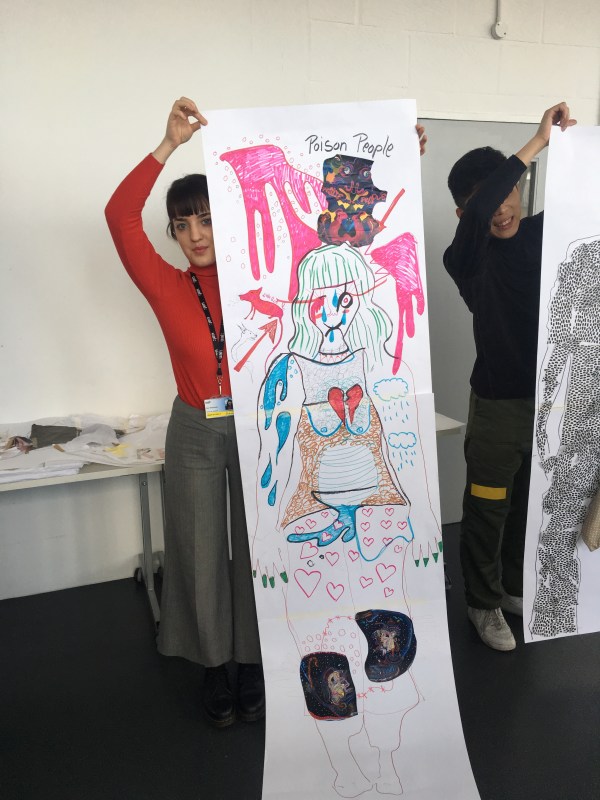
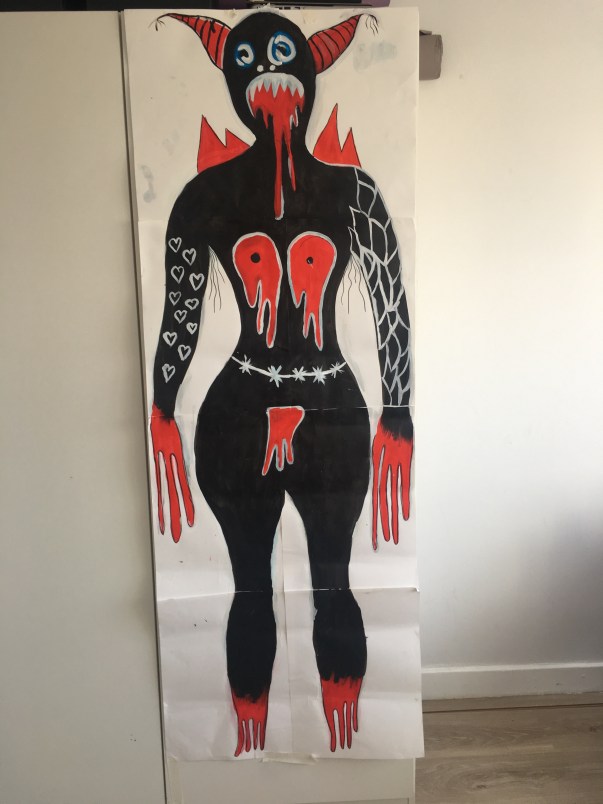
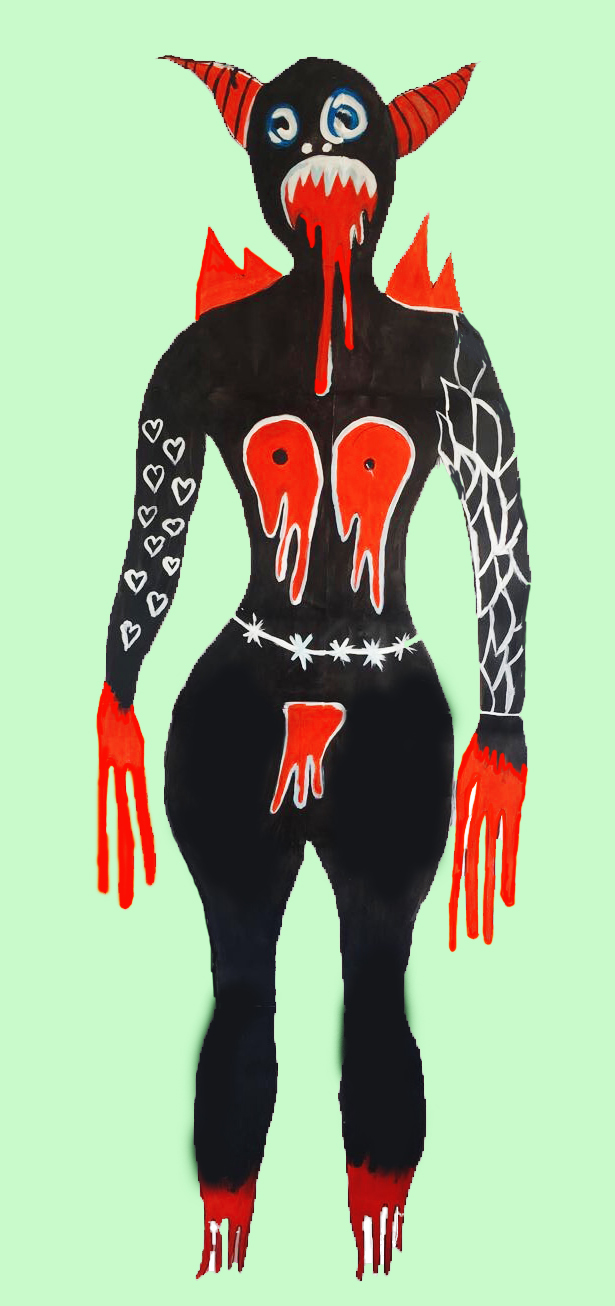
From my first creation I improved it to my second creation during the same day. I was very pleased with my second outcome because I was more focused and used acrylic paint to achieve this. I have highlighted my fear of death, which clearly builds most of my character. Death itself is a mystery, but not knowing what happens to our soul makes me feel all the goosebumps. As well as death, the idea of sexual abuse is a fear. The idea of a woman being sexually abuse makes my heart beat so fast- hence the naked parts being revealed. In addition, having my heart broken makes my dizzy, and afraid. Loosing myself in my head and imagination is a fear I feel like that might come at any time.
The creation of my monster, is a mirrored reflection of me and my fears. From my perspective, it seems quite dramatic and horror- like. However, I don’t think I would change anything as it is very personal. The experience taken from this exercise was very much therapeutic and allowed me to understand and look closely in my fears which I’ve never done before. Allowing myself to have this conversation with my mind made me think about overcoming these fears, or think where they have come from.
Workshop two: Macro/Micro 15/02/19
”E-x Machine” movie
Jubebox Jive workshop 15/02/2019
During the Jukebox Jive Workshop, our first task was to rescale our character, print it and create character development while thinking about the movement of my monster. How it looks from the side, from the back and how it looks like when it moves in different directions. Second part was receiving a playlist called the Jukebox Jive. The playlist consisted of 17 songs. I was asked to choose only one song, think about the words and the story being told in this song and develop it as a 6 story narrative.
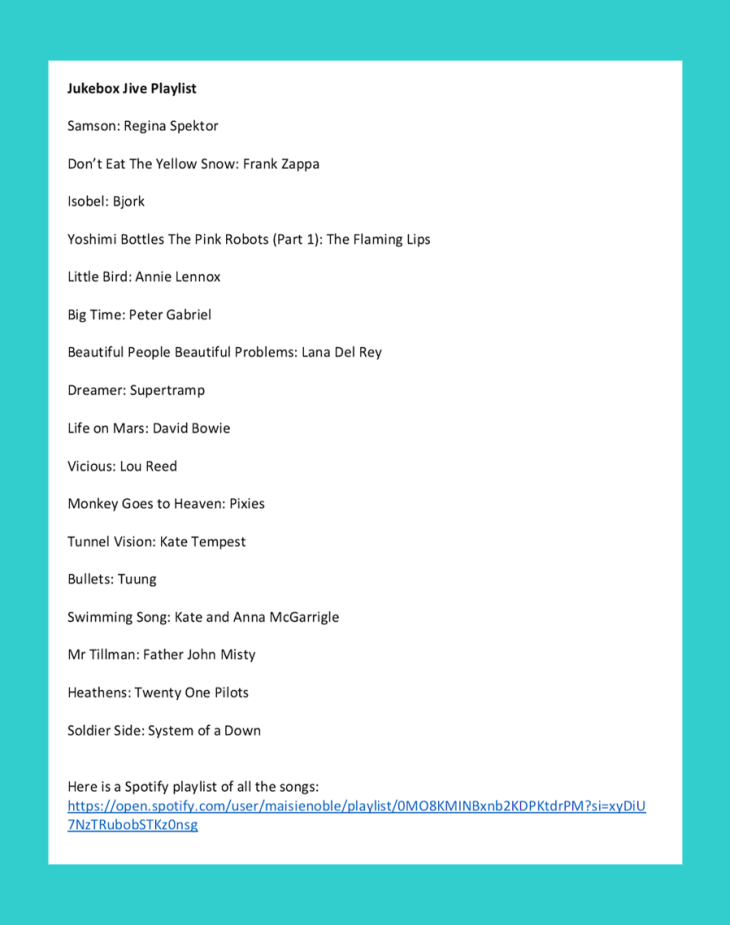 From the playlist I decided to firstly focus on the song Bullets: Tuung. This song worked pretty well with my style of drawing, I thought about many different narratives while listening to the lyrics. However, the song song I have listened to was Lana Del Rey- beautiful people, beautiful problems. This song has caught my ear, and the lyrics, which almost remind me about heartbreak and the lost of a loved ones. I decided to work around these lyrics.
The restrictions placed upon is using only dry media materials, (no paint, no ink) and we were restricted to only three colours. The 9 frame templet we were given was only given to us once, and it was A2 size. The purpose of this exercises is to see how we can adapt and consider working to professional specifications and formats, as well as to see how we have improve our narrative again and again.
Colour and Narrative lecture 18/02/2019
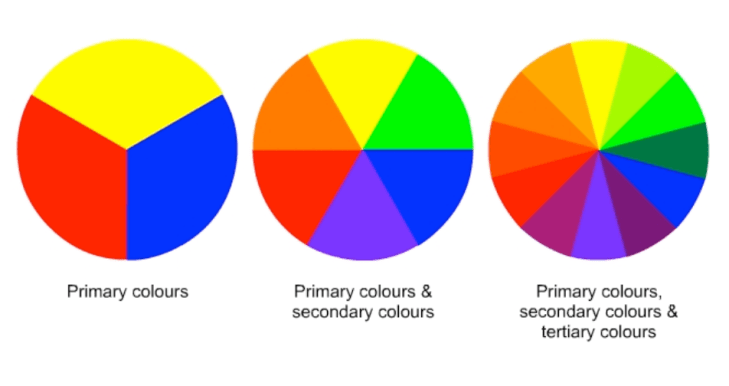
Art Therapy with children- how children react to colour and The Importance of Colour in Children’s books
Colour is especially important in children’s mind, from early age. Their developing minds of colour provides a very powerful learning about the world, visualising a spectrum of the world in the growing mind can affect their later growth as a human being. The importance of navigating this world through the use of colour, in a memorable, healing, honest and positive way of the world is very important.
The stimulation of children’s mind and how they grow from the start reflect on their decision-making/ life choices. When the experience the world through positive experience which include a very careful choice of colour through the exposure of life changes many aspects. For example, the vibrant and vivid colours
Research ‘Colour In Art’ by Josef Albers
Colour is determined by the ‘’the internal surface structure of the objects that reflect some wavelengths of light and absorb others’’ (John Gage, p7) which means that it is both important to understand the context of colour and their physical state of being. Such as understanding what they are associated with, and how they reflect on human physical state such as their emotions.
Colour is a set of wavelengths which we as humans understand as ‘colour’ but actually is a radiant energy which exist on earth but it is invisible for the human eye to see. The part in our brain which is called retina converts physical state into electrochemical energy, which connects to nervous system and into the cortex of brain. As humans we are constructed to discriminate between millions of colours but our brain only chooses to see only the limited numbers through the shells we create in our brains regarding everything we experience and through out five senses.
Early 19th century, the cone function of retina depended on the earlier categories of colour which were the three primaries. It was not the primary colours of red, green, and blue but in this case red, blue and yellow. The practice of mixing colours was not so explored due to nature not being interfered with man’s nature. Change was wrong at the time because it produced conflicts and most importantly change which confused people of their existence.
Sensation means a physical feeling or perception resulting from something that happens to or comes into contact with the body.
Perception means he ability to see, hear, or become aware of something through the senses.
Inference a conclusion reached on the basis of evidence and reasoning.
‘Chromophobia’ by David Bachelor
Chromophobia means a fear of colours, a clinical phobia which is very rare and can open many different hormonal responses and psychological reactions.
Colour and Autism
Autism is a disorder that is characterized by difficulty in social interaction and communication through the restricted or repetitive patterns of thoughts and behaviour. Especially for this disorder in children’s and adults, the needs of colour selection is really important due to the fact that colour can have different effects on their well-being. It is said that people with autism spectrum disorder have ‘’higher sensitivity to colour differentiation than non-autistic people’’ ( Turner, 2017) and all the five senses are experience much intensely.
For example, the colour green represents a lot of safety and harmony, and this colour is said to work well with autistic children, as well as lights pink.
The neurodevelopmental disorder a delay within milestone in children. This can include Neural tube Defects, cerebral palsy, intellectual disability. The neuro disorder in brain
The Sussex Baby Lab
A group of researchers that are led by a professor Anna Franklin, conducts research on colour perception and cognition in order to understand how humans see and interact with colour, to address broader theoretical issues in cognitive and developmental science. This lab is made to help how to understand how humans perceive and process colour and how this develops through our early and adults years. The things they stand for and investigate
(University of Sussex Colour Group, Anna Franklin)
By using three significant methods, they study how babies learn, think and see. The first method if called eye-tracking, where they use a the eye tracking camera that helps to detect the movement of the eye when the baby is looking at the screen.
Quotes:
‘’Our brains works so selectively,that they only see what they want to see and they ignore the rest’’ (Dots,Włodek Markowicz)
‘’The retina records and transmits sensation not perception, the recognition of a single colour depends upon complicated cerebral processes, such as inference and memory.’’ (John Gage, p8)
Artist Camille Rose Garcia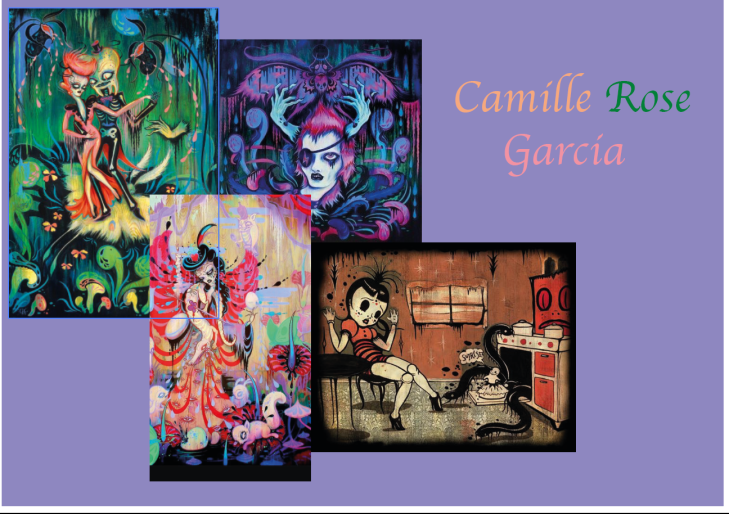
Referencing:
https://www.happydesigner.co.uk/the-importance-of-colour-in-childrens-books/
https://www.theguardian.com/lifeandstyle/2017/apr/11/vision-thing-how-babies-colour-in-the-world
http://www.sussex.ac.uk/babylab/
http://enduratex.blogspot.com/2017/04/color-and-autism.html
Colour in Art by John Gage
Final Critique presentation for Hand and EYE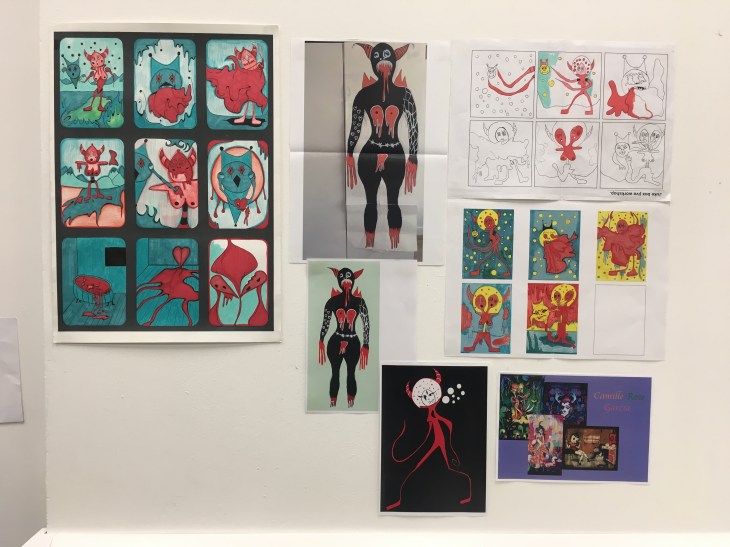
As part of the Hand and Eye project, we have been ask to present our 9 frame narrative inspired by a song. Overall, my presentation went good, however it could be very much improved in terms of my confident side on being on the stage and allowing everyone from my group to look at the work. The presentation could have been improved in terms of my presenting skills which I have not practiced beforehand. I did not explain everything that I wanted, because the stress have eaten me from the inside. I have missed some many important points like the research I have done, and how my idea was presented to my class. I was shaking and could not clearly speak. I want to improve my presentation for the next project, this could be done through preparation of notes in a bullet point style, so I know what comes next to speak about.


However, I have received some positive comments and improvements for my narrative. People from my group, felt very emotional from looking at the story and it was clear to them what I was trying to show. They have said that the use of turquoise and red works really well together. I have heard that my style reminds someone of ‘Adventure Time’ which is very interesting to look at! I also heard, that it reminds them of Opera, that everything is very nicely staged out.
In addition for my improvements, I have to focus on the body language of my character, because it was hard to tell what he feels. As well as, try to work on my evil character the little one, because he looks similar to my red monster. The biggest issue, was having my narrative portrait, which was one of the restrictions placed upon us, and I think I have not been aware of this. Therefore from my portrait narrative which I have finished I have to re-create another one using the landscape method. In my opinion portrait version looks much better, although I have to work towards the restrictions in order to complete this task correctly. The good aspect about this, is receiving the template again and by using the critique presentation I can improve my final outcome to high standards with my story board being well thought.
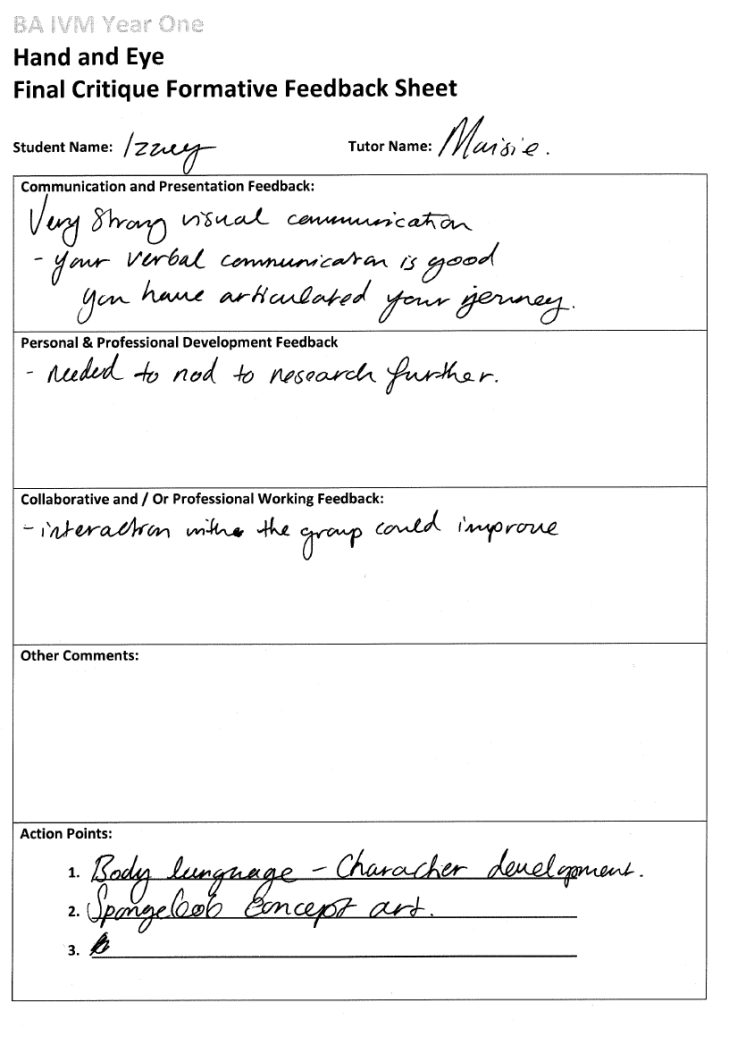
YEAR 1 IVM STORYBOARD EXHIBITION
Evaluation for final project:
 Despite my deepest thoughts