Task One brief encounters
01/10/18 – 05/10/18
To start my project titled as ‘everything is new’ I have been asked to create four brief encounters and respond to these using my individual personality and style. The first brief encounter, asked to be from a free magazine or newspaper. I have used a free magazine from reception desk and created a collage by finding interesting pages and tearing them apart. Lastly, I have used illustrator to work on top of the collage. I wanted to portray the number 3 here, because it represents the three years that I will be spending in London college of communication. 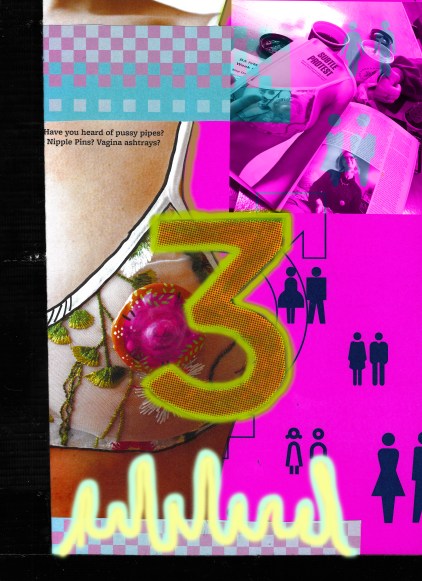
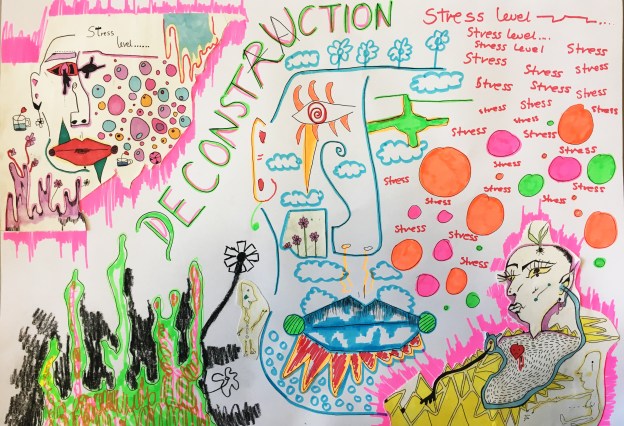
The second brief encounter asked to be from a real life (a 1 mile radius of Elephant & Castle) I decided to draw out my feelings that represented my first day in the school. This included my first day of exploring LCC. I like using vibrant colours therefore I thought these colour combination will suit together. The illustration mostly represents stress emotions in a colourful bubble of joy. 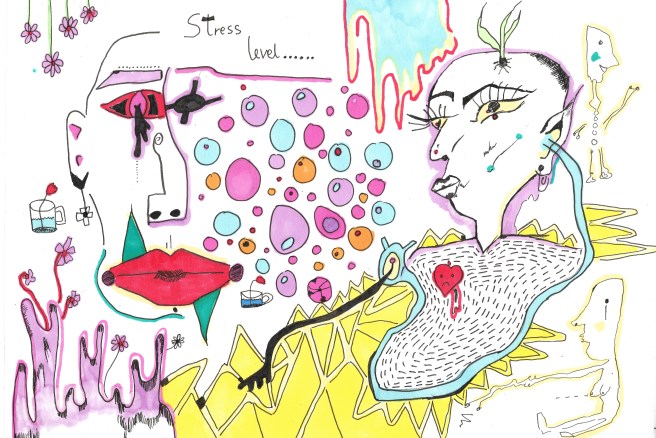
The third brief encounter asked to be from a UAL library book. I have grabbed the first book about learning how to draw hand movement. I have taken this into practice and went on to draw my hand representing this with later development on illustrator, by adding colour, contrast and brightness.
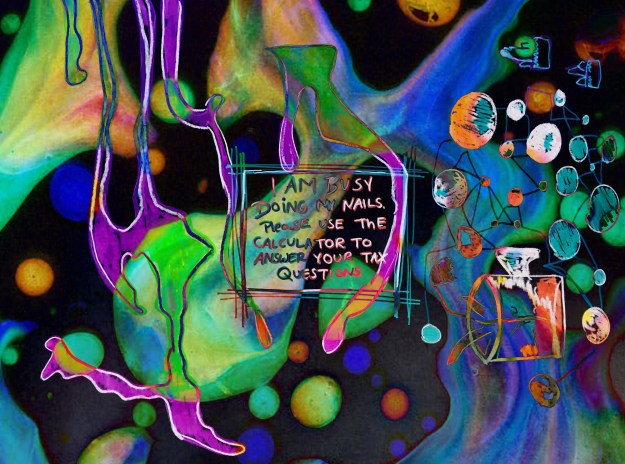
The fourth brief encounter asked to be from an online source (social media, website, article, chat rooms) I decided to work on top of the picture that I took in LCC and posted on my Instagram. The picture shows a very unexpected writing which I have come across while exploring the areas of LCC. I think this was a part of some kind of exhibition that was going on, on the first floor of the building. The text ”I am busy doing my nails. Please use the calculator to answer your tax questions” has intrigued me. I printed the picture using black&white edited effect and used glass paint on top of it to great suspicious effect. 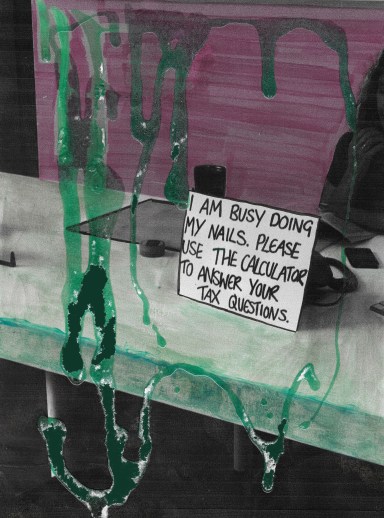
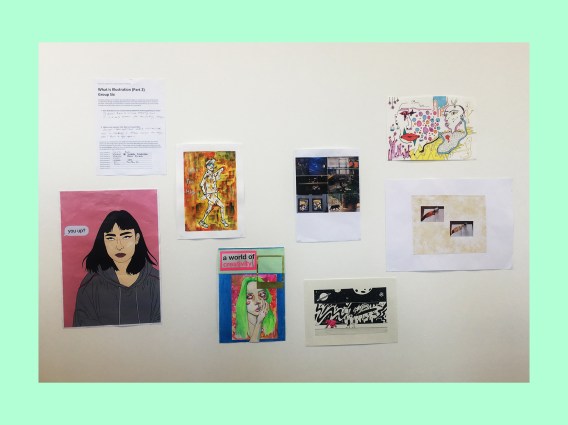
The last part of this task was about getting into group of 6 and considering the nature of illustration, as well as selecting one illustration from each person that communicates ideas about the nature and philosophy behind the discipline of illustration. We have also been given two questions that we answered together as a group.
1.Does illustration have to include drawing? – It doesn’t have to include drawing, but it is mainly known for including drawing. However, other illustration skills like photography are also known for it, but drawing on top of the photograph or making a collage of out it, creates an actual illustration. We think illustration is whatever leaves a mark on the page.
2.What is more important: skill, style, or concept? All are important however without concept the meaning behind your art would lose its understanding for the artist as well as for the audience. All three points are like a journey for the artist, but the first point that should be considered as a main is concept.
Deconstruction
05/10/18
During our workshop, we were de-constructing our brief encounters, ripping them apart, and doing multiple exercises in order to understand the idea of recreating something completely different from what we had when we first started. It is important to understand that what you have first created can be change or distorted into something different, this is a way of pushing our ideas further, and not ending on just one idea.
The aim was to understand the different exercises, like picking one section of the drawing and creating it really large, and adding another brief encounter to it. Charcoal was also used, as a way to exercises our drawing skills and in order to be free with yourself. I found this exercises helpful and really calming, because it allowed me to be free with my vision and with whatever that I wanted to draw with. I have created two different illustration out of my brief encounter, although I am more proud of the first one as it is very chaotic and with a lot of colour, whereas the second has less drawing and I could have probably added more different elements to it therefore to push it a little further I have also edited it on illustrator to add more feelings to it.
Reconstruction
12/10/18
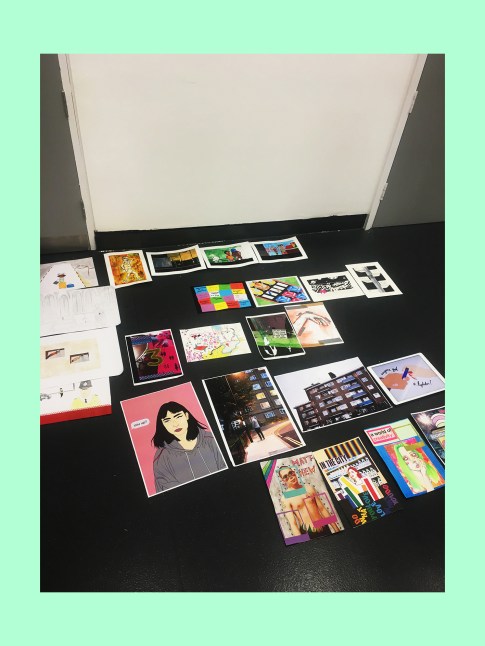
The Reconstruction project was one of my favorite because it allowed us all to make something together while combining our skills and passion into one. We have started this workshop with learning how to use printer, so during studying we know how to print, change colours and sizes. The first task was to go to the library and scan our brief encounters and play around with colour. We could print them any size we wanted, so then we just cut the best parts or leave them as they are. After this, we placed all illustrations on the floor and as a group we could pick any that we liked to use for our micro magazine.
This exercise was good because we could see everyone’s illustrations, styles and skills. It was really interesting to see what illustrations everyone would pick to create their micro magazine. As well as picking illustrations, we could decorate them with anything we wanted, this allowed us to play around with people’s outcomes and at the end show this micro magazine as a way we think illustration is defined as.


Final outcome Micro Magazine
19/10/18
As a part of our ‘Everything Is new’ project, it was all about the discipline, studentship, technology awareness, collaboration and creative critique. Starting our first year journey with our brief encounters that represented our first week at LCC. It was very intriguing to slowly discover everything new to us, the tutors, our colleagues, new environment, and workshop areas. Because it was a collaborative workshop, the magazine that I have produced includes other people’s illustrators that I really liked, and my idea of displaying them in my magazine and adding colour.
I have mainly focused on colour coordination with my magazine. I have picked out illustrations of other peoples work that I could combine together in on one page. It was interesting to work with other peoples illustrations because everyone is so different and there is so many little stories within each drawing.
What I liked most about my magazine is that I have cerated it as a collaborative piece of work. The only illustration that was mine, was at the back of the magazine, and I have also decorated some pages using paint and markers.
I have also made my own magazine with my own interpretation of what is illustration that includes only my work and the brief encounters put together with some more illustrations that I included in the magazine.
How to Critique
26/10/18
Starting our workshop with brainstorming the meaning behind the word ‘Critique’ As a group we have discussed and said that critique is all about honesty and opinion. It is a good opportunity to give your opinion but at the same time allow yourself to gather inspiration from people’s work. It is reviewing, analysing and giving feedback. It is important to receive criticism as it gives you the opportunity to improve your work, every artist has different styles and opinions, therefore it is good for you to get feedback from different fields. As artists we spend so much time creating our own work, for an example a painting that we have been working on for so long, a fresh and different eye can see some mistakes that is better if they are pointed out before we submit our personal work. Lastly, as a group we have said that critique is Inspiration from other people’s work, it’s the improvement of your work, analysing something, clarity, honesty, opinion, understanding, appreciation, review or feedback.

The first activtity that we have done during this workshop is reciving a an image with an artist work that we didn’t know about from our tutor and talking about it in our group. We had to critique it and answer
At first what we said as a group is that the illustration reminds us of fashion illustrations. However,
The idea of taste
, giving your own opinion but thinking about referencing, usefulness for the other person
what words are appropriate to use and when critiquing
(judging something without having all the evidence)
subjective a statement or comment developed based on the commenters personal opinion beliefs life and dislikes
objective: a statement or comment developed through factual evidence and without being influenced by a personas beliefs opinions or bias
discussion:
-how biases and stereotypes hold people back
-counteracting fixed mindsets with growth mindsets
workshop aims:
- intro to stereotype threat and implicit bias and consider the impact that these have
- be aware of stereotypes and biases and their implication
- to think critically about de-biasing strategies
- to consider own biases and set goals
opening activity:
in pairs share
- what your name means
- how its pronounced
- the story behind it
-first lecture was about the way we use the word talent and deconstruct fixed mindsets
what is implicit bias? why does it matter for justice, equity, diversity and inclusion?
-refers to the mental processes of perception, memory, judgement and reasoning, also known as
cognitive bias.
cognitive biases arise because our human decision making processes are not just factual or objective but are influence by a variety of factors and help us live efficiently
characteristics of implicit bias:
- unconscious and automatic
- pervasive
- do not always align with explicit beliefs
- have real-world effects on behaviour
- are malleable
if you google famous artists/designers most people that come up are male and white.
List of biases
- Colour-blind racial attitudes: the belief that discrimination no longer exists discounts the experiences of people of colour
- Competency proving: some group members have to demonstrate that they are qualified and competent.
- Failure to differentiate: mistaking one person or another by someone of a different group
- Racial micro-agressions: brief and subtle comments, behaviours, or environmental cues that intentionally or unintentionally communicate hostile, derogatory, or unwelcoming messages toward members of underrepresented groups
- Stereotype threat: when awareness of negative stereotypes about one’s own group induces stress and anxiety about confirming the stereotype
- Tokenism: treating members of minority groups as representative of their entire group rather than as individuals, especially when they are a numeric minority or the only person from that group present.
Stereotype threat is a social-psychological predicament that can arise fro widely-known negative stereotypes about one’s group.

 Despite my deepest thoughts