Unit Title: Exploring Studio Practices
Sorry We Won’t be long- Climate Change project
Sequences and time: Aims and context of this brief is an awareness raising, social networking/ film project. This studio workshop looks at the construction of the time-based and event-based image. It helps to look at the historic and contemporary role of the narrative in visual culture .
”Friends of the Earth are currently disseminating a viral social networking message that we have only 12 years to save the planet from the worlds temperature reaching a catastrophic 2 degrees higher than what is deemed safe for life to exist. As you read, many thousands of people are protesting on the streets to alert politicians and big corporations to urgently address climate change.” (taken from the brief)
This project asks me to consider how I can inspire people to change their thoughts about the environment, to change their behaviour and change their attitude about climate change.
”Climate change is happening, ice caps HAVE melted and the global temperature IS rising.”
In a non militant way I am asked to create a 2 minute animation or film, that can be shared to social networking. I am asked to consider how positively I can change their minds of people who does not understand the full risks of climate change.
The objective is: to raise public awareness as a strategy for social and political engagement, to experiment in variety of methods of observational image making to record most effectively the key visual prompts to inform audience, and lastly to
Before the Flood: Documentry Research
I have started my research with a documentary ”Before the flood” which was created by Leonardo DiCaprio in 2016. The documentary shows DiCaprio meeting with scientists, activists and world leaders to discuss the dangers of climate change and possible solutions. This documentery allowed me to learn and understand the issues of climate change. What has inspired me was the entry and ending of the documentary where DiCaprio talks about a painting by Hieronymus Bosch called The Garden of Hearthly Delights. DiCaprio says;
” It was painted around 1500, and if you look at these panels long enough, they start to tell a story. In the first panel you have Adam and Eve in the garden of Eden. Birds flying into the distance, elephants and giraffes and a lot of religious iconography. The second panel is where it starts to become more interesting. The deadly sins start to infuse their way into the painting. There’s overpopulation, theres debauchery and excess. And the last panel, which is the most nightmarish one, especially from a young child’s perspective, is this twisted, decayed, burned landscape. A paradise that has beed degraded and destroyed.”
 The Garden of Earthly Delights by Hieronymus Bosch 1490
At the end of the documentary after Leonardo went through a journey that has taught him more than he knew, he said
”The story of Garden of Earthly Delights, actually begins on the outside of the painting, where Bosch painted view of our Earth on the third day of creation. It’s almost as if he wanted to show the fragility of our planet by depicting the Earth, and it’s atmosphere enclosed in a glass, Human kind before the flood.”
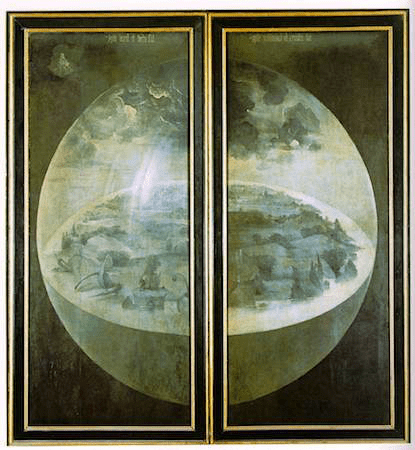 Afternoon Delights, Creation of the World
I think the way the documentary was portrayed and all the significant symbols shown, was beautifully devastating. How Leonardo Di Caprio portrayed the Climate change issues made me realise how much I still don’t know. One thing that is stuck in my mind when Di Caprio was talking about the animal extinction,
”From the very young age, I have been fascinated with species that had become extinct. All these different animals. From the dodo, to the passenger pigeon, which was the most plentiful bird on earth, to the Tasmanian tiger also known as the thylacine, to the great auk, the quagga, the Moa. I remember the anger that I felt reading all these stories about how explores and settlers would just wipe out an entire species, and in the process decimate the eco system forever. Well, we are doing this now.. but on much higher scale.”
This made me realise how blindfolded we are in this world. How much there is truth in the paintings that Hieronymus Bosch painted in 1500, how could he know that what he is painting might become a truth some time in the world? was it his imagination that led to this, or the truth about human race? or how much everything was moving so fast, so quick?
You know the view from my window house in full of nature. Full of trees and all the good green stuff. The biggest reason why I have moved out here was because this place looks nothing like the London city. I wake up and from my window living room there is this big forest that leads to so many destinations with beautiful lake. I love this space because while writing and watching all these documentary I feel upset about the human race, that somehow we led to this catastrophie, because all we can think about is our needs and how we can survive this.


Pictures taken by me using analogue camera title ”new house”
Most of our economy is based on fossil fuels, coal, oil, natural gas. Oil powers most of the transportation sector, coal and natural gas power most of the electricity. In order to sustain our dependence on fossil fuels, we’re going to very risky new sources like mountain top removal for coal, fracking for natural gas and offshore drilling for oil.
Anja Rubik PLASTIC NOT FANTASTIC
”Anja Rubik is dedicated to making significant environmental changes in the fashion industry. Together with non-profit organization Parley for the Oceans and PORTER, the supermodel heads to the crystal waters of the Maldives to discover the vast impact of plastic pollution, how brands can embrace eco-innovation, and what we can all do to save our seas. Photography MARIO SORRENTI. Styling CAMILLE BIDAULT-WADDINGTON” (Danielle Radojcin, 2018) from NET-A-PORTER


Pictures from Anja’s Rubik’s instagram feed
”What we are trying to do is highlights the beauty and fragility of our oceans, and to invite the fashion industry, especially luxury brands, to collaborate. We have passed the point of raising awareness; now it’s time for solutions that can be scaled quickly” – Anja Rubik
”The Summer Escape issue features a 63-page ocean portfolio, shot exclusively in the Maldives by acclaimed photographer Mario Sorrenti, in collaboration with Parley and eco-warrior, supermodel and guest editor, Anja Rubik. Sorrenti’s images contrast the beauty and the fragility, showing the stark reality and vast impact of plastic pollution; while the editorial dives into how we can all be more responsible, rethink our standards and embrace eco-innovation.” – (Parley.tv, 2018)
Fight For Your World Advert WWF
”You see the problem is we think we have time. We are the first generation that knows we are destroying the world, and could be the last that can do anything about it. This is a choice. The food we eat, the things we buy, the way we live. We can win the biggest battles in the smallest of moments. in very second, of every day. Are you for the world? or against it? Its time to decide. ”
Greata Thunberg
Daniel Webb
https://www.muralbythesea.co.uk/editions
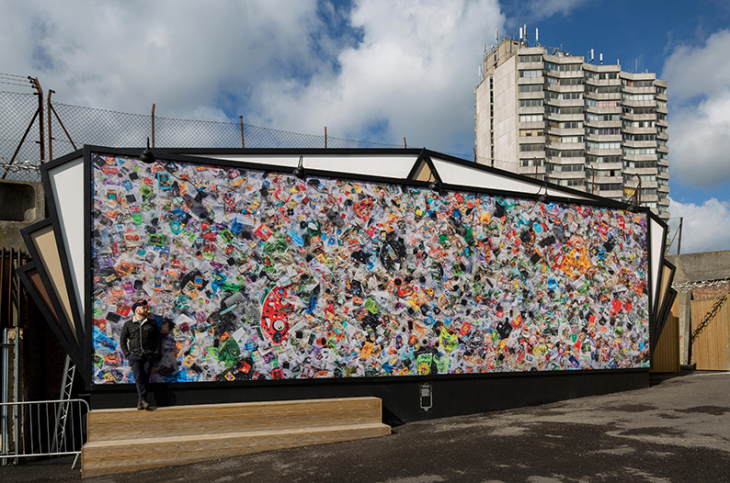
MOCAK- Museum of contemporary art in Kracow Exhibition ”Nature in Art”
https://www.mocak.pl/natura-w-sztuce
I have attended an exhibition in Kracow, Poland called ”nature in art” which talks about the responsibility from people towards ecology and responsibility as a species, towards nature. The exhibitions showcases how widely the spectrum of artists approaches this issue. Thinking about the human race being part of nature, and the vagaries of evolution, and how nature took the lead of evolution. By combining these two aspects; human being a fragment of nature and at the same time being this mechanisms which has to have the feeling of responsibility for what is happening to the nature. The exhibition wants to bring awareness to the nature because if we don’t we put ourselves in the danger. To treat nature without that awareness is disgusting almost a declaration of the suicide of the species.
The exhibition is divided into five sections; beauty, ecology, confrontation, matter and symbol. In beauty; artists portray beautiful landscapes of nature, in order to contemplate its beauty in many significance way. Ecology deals with the safety of nature, and encourages the protection of the environment. The confrontation revolves around the crash, or integration of the artists with the forces of nature, in a way that challenges and faces the natures problems. The matter refers to the artists using organic substances, in order to show the most faithful representation of the structure and expression of a given structure. Lastly, the symbol, refers to the representation of animals that provide a reflection on transience and passing away, illustrating human traits and features.


Few pictures taken by me from the exhibition ”Nature in Art”
I was greatly inspired by this exhibition especially when seeing artist:
Book: The Sixth Extinction by Elizabeth Kolbert
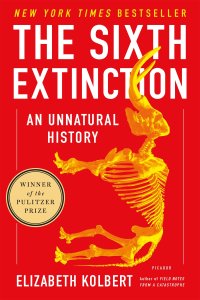
During this project, I was greatly inspired by the book ”The Sixth Extinction by Elizabeth Kolbert” which talks about
Creating collages from Plastic
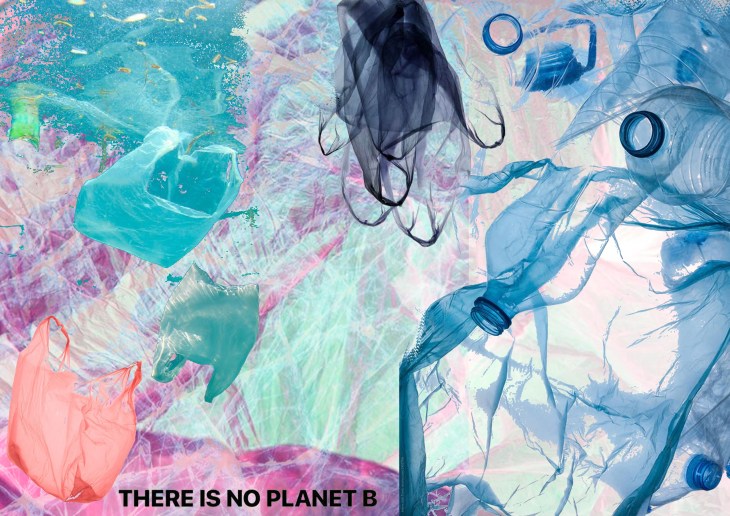
Collage inspirations made by me in order to visualise my ideas about plastic pollution
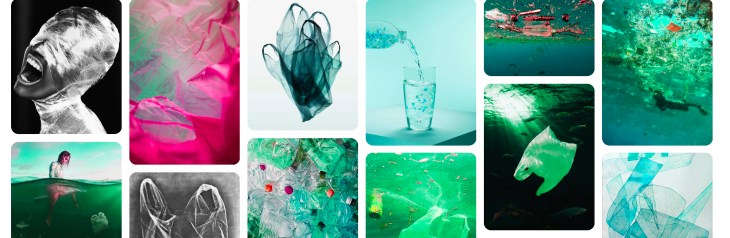
Inspiration found on Vimeo
Creating Photograms in Photography Darkroom
I have created photograms in the darkroom as an experiment to create the atmosphere of a plastic being under the water as a cause for pollution.
Photogram is a type of contact print, made without the use of a camera or negative.It is created by placing objects on light-sensitive material and then exposing it to light.
To create photogram I have begun with a white light with a sheet of plexi glass, when I was satisfied with my composition of using plastic materials such as bottles or forks, which I thought were quite effective I have exposed it in the darkroom. It is really important to create a dynamic composition using unique objects that evokes a very specific mood or feeling, and exemplifies a dynamic composition.
The process of developing my photographic composition, is to firstly place paper in the developer tray, gently tapping the edges with tongs to ensure paper is fully submerge. By Rocking the edge of the tray to agitate the paper ensuring there are not many bubbles and processing it for at least a minute, made my photograms successful. At the end of the development process there’s a stop bath. I have taken them over to the drier, which immediately dried them for me within 3 minutes.
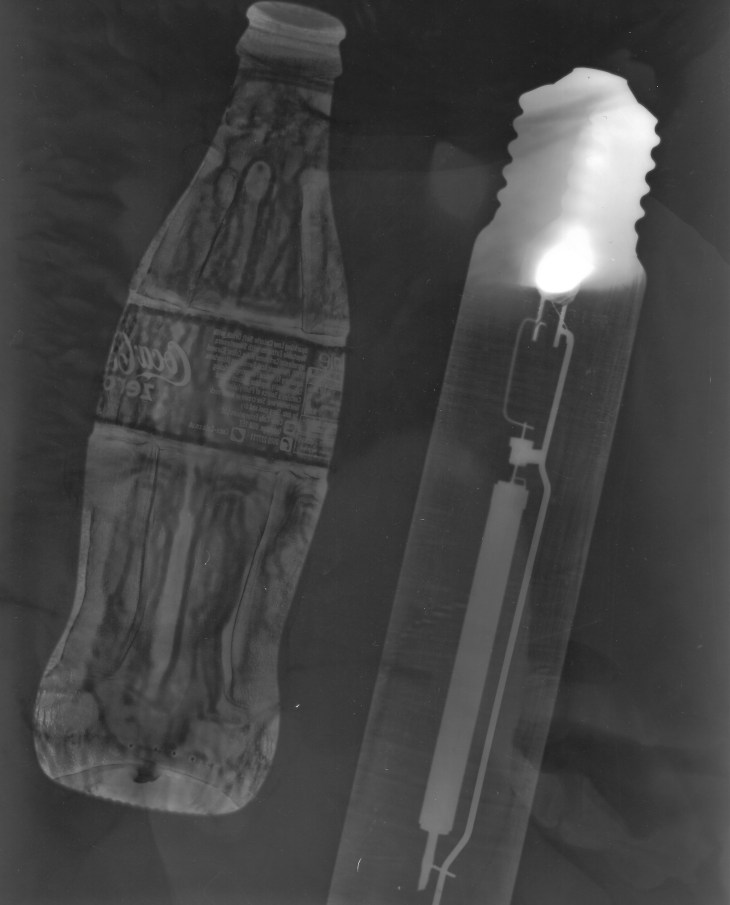
From Black and White prints freshly developed in the darkroom I have scanned them and edited each to give them the aesthetic of floating under the water portraying the dirt found in the deepest of the ocean, the lungs of our planet.


Photograms from plastic ”In the deepest of ocean” created by myself


Photograms from leafs and broken flowers titled ”Nothing lasts forver”’ created by myself
Final outcome movie
My concept idea was focusing on the plastic pollution of climate change. Throughout my research I have been inspired by contrevasial and catchy images of the model Anja Rubik.
I really liked the idea of showing the ocean as the lungs of our planet; and therefore raising awareness towards plastic waste.
I have also produced photograms in the dark room using plastic waste; and edited them so they look like they are in the clear ocean.
How? Through the idea that plastic can kill us, and that it is very destructive for our life’s..
The people I want to persuade to change their ways; is young teenagers because I think they have the power now to change the world at its crisis.
For my final piece I had used footages from a source where Plastic is in the ocean, I have taken few videos from this source:
https://www.youtube.com/watch?v=1P9syq3f6hQ&t=3s
The reason why I have taken view footages from this specific video, is because I could not go to the ocean and record this kind of footage. As well as, my music for the video is by Bones-Oxygen, this is the instrumental version.
 Despite my deepest thoughts