The definition of illustration from English dictionary is ”a picture illustrating a book, newspaper. For example illustration of a yacht.” or ”the action or fact of illustrating something: by way of illustration, I refer to the following case.”
04/10/18
In my opinion, the definition of illustration is when an artist uses their creative imagination to create an image through the use of many different processes and techniques. I think illustration can be interpreted as freedom of the artist heart. Each artist is different, therefore there are different types, styles and genres of illustration. These examples include typography, advertisement, graphic design, tattoos, logos, road signs, packaging, magazines, children’s books, prints, photography, fashion illustration, mixed media, graffiti, maps.
Moving on, specific artist may include specific genres for instance; horror, romance, classical, fantasy etc. Other disciplines related to illustration are sculpture, 3D Design, interior design, automobile design, wood cutting, jewellery design, commercial branding, game design. This is all to do with freedom of expression which I highly believe in, when being a part of an art industry. Being able to be open and individual about your work
There is always a lot of misconceptions about a ‘designer’ and ‘Illustrator’. A designer is a person who often works with images and typography in order to create unique compositions and more importantly focuses on the visual concept in the viewers mind making the details and idea to be the centre of focus. On the other hand, being an ‘Illustrator’ is all about producing the imagery and visual meaning into the final design product-but not always. The final design may just be the imagery. It is often though that both illustrator and designer work together to combine both of the skills in order to create this final product like newspaper, magazine, books or articles. Sometimes they switch their jobs, and an illustrator might as well be working in areas that a designer works in It really varies what skills a person has to offer.
By doing further research I have come to the conclusion that an illustration is a visual imagery that visually communicates a certain topic, brief or it is used as . Because each illustrator is so different, the beauty of this is that every illustration can have their own unique style.
Image V object Collecting and Archiving Comic Books
11/10/18
Today’s lecture was about the idea of collecting comics, and how illustrated works are categorised in archives and special collections. We have looked closely at the artist Les Coleman who was also a critic and a writer. Coleman’s family have left his collection to UAL in 2013 with mostly Alternative Comix and underground.
Differences between original comics and reprints: These differences always vary by publisher, brand, series, print date in order to make it harder for the collector to know. The first editions of the comic will usually have a ”1” or ”first edition” printed on the cover. In addition, checking the date of the comics often gives you the inside of the age because valuable comics are often older. Paper and ink slowly deteriorate therefore a comic that looks new and says that it is first edition it is more likely to be reprint or forgery.
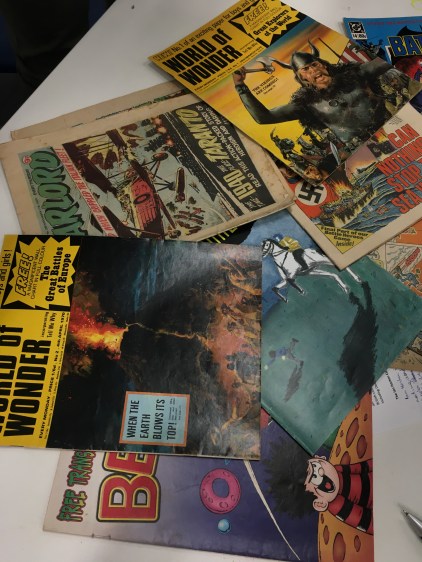
During our session, we were asked to write two catalogue entries for two chosen comics. Writing catalogue entires is a good practice in order to look closely for specific details. The comics collection that we have received were from our lecture teacher Ian Horton, from there the second task was to describe how we perceive his taste in comics.
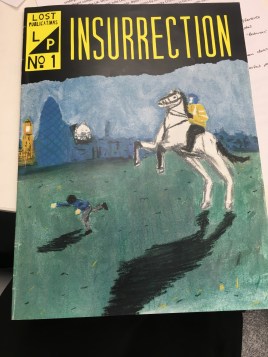 catalogue entry 1:
Title: Insurrection Lost Publications no.1 Unique code: 1137
Description: published by Lost Publications, all text and graphics copy right Russell Stearman. Names and characters are fictional.
Creator name: Russell Stearman
Date: could not find the date.
Physical description: black and white pages, glossy paper as a front cover making the comic very smooth and easy to carry, I believe it was made digitally or by hand with black pen, large bold text as a title page.
catalogue Entry 2:
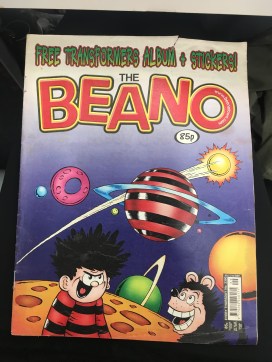 Title: ‘The Beano’ No.3390
Description: Colorful cover portraying the character, typography is bold and dramatic showing joy.
Creator name: printed and published in Great Britain by D.C Thomson and Co.
Date: July 21st 2007
physical description: smooth pages, delicate pages printed on newspaper paper, pages are very easy to rip apart and smooth, colorful pages inside, the inside pictures are framed with black outline.
The Ian Horton: Ian Horton is a lecturer, comics collector and artist. He has a really diverse collections of comics, with lots of difference audiences and ages. His collection includes very famous collections such as; ‘The Beano” and ”Batman” whereas other and known by small audience of people. He keeps his comics in a see through packages to keep them clean and so the pages won’t fold over. The comics consist of black and white and colourful pages, which shows his various interest. His collection represents his passion through his personality. We can clearly see this with the way he portray himself during lectures.
Transnational Histories
Traditional art history, euro-centric bias, the story of western art, culture flow, percpecive power and historical legacy. Keywords: Japonisme, Art Nouveau, primitivism, Cubism, cultural imperialism, soft power, Manga, Anime, fandom, cultural appropriation, exoticism.
Top 10 artists in our group:
- Marcel Duchamp
- Henri Matisse
- Claude Monet
- Pablo Picasso
- Paul Cezanne
- Sandro Botticelli
- Van Gogh
- Paul Gauguin
- Jackson Pollock
- Donatello
- Salvador Dali
- Jean Micheal Basquiat
- Andy Warhol
- Frida Kahlo
No Google
Looking at database,


Why reference? essay
26/10/18
Why Reference?
In my opinion Referencing is used mainly to avoid plagiarism. Plagiarism is a very known subject across art industries. The article about ‘’What is Plagiarism?’’, talks about the deeper meaning of this word. It is said that ‘’plagiarism is an act of fraud. It involves both stealing someone else’s work and lying about it afterward’’ (2017) The result of plagiarisms is an ongoing cycle for future referencing, in order to help find better connection between anything to do with someone’s original work. To avoid being accused of plagiarism referencing is a good idea. This can help you to show your inspiration from an artist work but not only, it is also a good tool to show your knowledge of reading these references, and passing it along another person who will read your work.
I think plagiarism plays a huge part of referencing, and why it is taught as an educational purpose. While doing my further research,, I have came across a very known article that is present about plagiarism. It is published in Harper’s Bazaar magazine, the online article is about a fashion designer Jeremy Scott who was accused of the act of plagiarism by Edda Gimnes. A growing designer Edda Gimmes, have said that ‘’ Seeing the Moschino show yesterday makes me so sad and I feel so hurt that someone has, the way it looks to me, unquestionably used my SS16 and SS17 collections as inspiration without granting me any credit.’’(Edda) she claims that a famous fashion designer used her fashion collection and therefore plagiarized her work. On the other hand, Scott does not agree to this accusations. This example, presents that the consequences of copying might be very serious- but how do we know who is right?
Moving on, other factors why we should reference our work is because of credibility that should be given to anyone that was mentioned in your work. I think credibility is very important because it allows the work of an artist to be explored when someone is talking about it, it shows respect and appreciation of someone’s talent and originality. By reading a book titled ‘’ The visual artists copyright handbook’’ by ( Henry Lydiate,1983) The book is written to depict the topic about copyright, what it is, how it works for artists and international protection. (Lydiate,1983,p.5) wrote ‘Artistic works are protected, so long as they are original and made by a qualified person.’ which suggests that there are three stages to have your work protected. The first test talks about artist work, and only works like paintings, sculptures, drawings,engravings, photographs can be protected. The second test includes its originality, it’s mostly about the ‘method’ and ‘manner’ (Lydiate 1983,p.7) Lastly the third test which tests if the artist is a qualified person, which I think is the most important part and asks for (Lydiate 1983,p.8)‘British subjects, citizens of the republic or ireland,personas domiciled or resident in the UK, companies in UK’
In conclusion, I think that referencing your work is really important and should be used by everyone. Talking from an artist point of view, I can say that I wouldn’t want my work to be plagiarized, because creating something original and unique means a lot to me, I think every artist would agree. Everyone want to be appreciated, and given credit for or being referenced for inspiration without stealing. Ideas and thoughts are often the same, but the the final product will always be different when created by someone else, this is whats special in this world.
Reference list for ‘’Why Reference?’’
https://www.plagiarism.org/article/what-is-plagiarism Turnitin,LLC ( 2017)
https://www.dictionary.com/browse/reference Houghton Mifflin Harcourt company(2002,2001,1995)
https://student.unsw.edu.au/why-referencing-important last updated:( monday 24, june 2013)
Henry Lydiate, (1983) ‘’The Visual Artists Copyright Handbook’’
Yayoi Kusama exhibition review
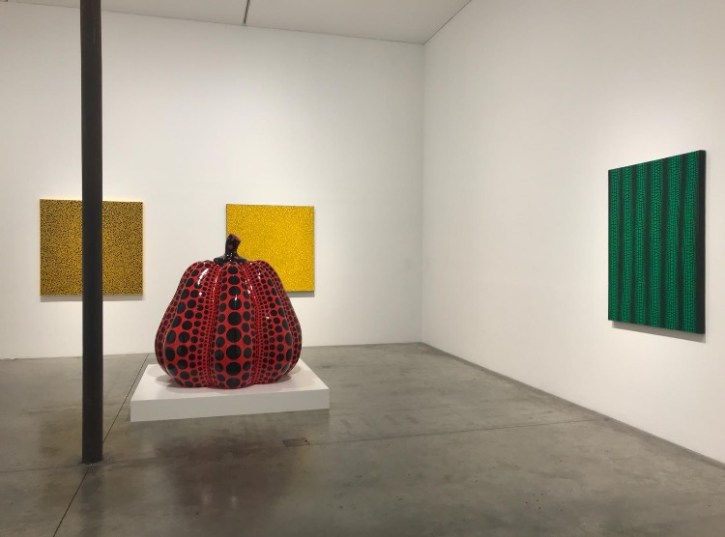
‘’Pumpkins have been a great comfort to me since my childhood; they speak to me of the joy of living. They are humble and amusing at the same time, and I have and always will celebrate them in my art.’’ (Yayoi Kusama)
As a young female in a Japanese culture, her family had a different perspective of Kusama’s life as an artist, they wanted her to be a housewife like every Japanese women at that time. Although with her rebelion side and escaping her family, she decided to pursue her dream, create art for millions of people around the world but also use it as a therapeutic healing for herself. Yayoi Kusama has showcased her incredible style that has a way of bringing the audience closer to the universe, with her cosmic infinity artwork as well as personal obsessions. I have visited Kusama’s exhibition at the Victoria Miro gallery.
My favourite part of the exhibition was definitely the infinity mirrored room filled with lanterns made out of circle and dots. Before entering, I could only see the white box room. While waiting in the queue to enter, I could only feel the mysterious atmosphere of not knowing what I am about to experience which I thought was fascinating. It’s the feeling of adrenaline and excitement at the same time. Entering the white box, and experiencing a complete contrast of the colours it’s almost as if you were to enter Narnia- another completely different universe. The originality that has been put into this mirrored room, is insane in such a positive word. The lanterns created a very cosmological experience, and the mirrors were used to create the illusion of infinite repetition of this reality. The effectiveness of this part of her work is that it brings people together to discover the universe with her. Inviting artists but also people that have never walked into the gallery or museum before. It is both eye pleasing for children and adult. It is something everyone enjoys to look at.


The curation of the exhibition was presented very freely, you could experience everything at your own timing. It was my first time at Victoria Miro gallery and this exhibition carried out four rooms, the infinity mirrored room, pumpkins, the flowers at waterside garden and soul paintings. Each section of the exhibition had its own atmosphere, for example the glass pumpkins have been spaced out accurately to allow the space in between them and around them
Portaterms
We were joined by academic support tutors, who ruined a workshop called ”Portaterms’ (a portmanteau word – Portable Terms)”
Seen and Not Heard: Considerations on Curating Public Exhibitions.
Key words: Victorian salon, museum, gallery, modernism, context, representation, spectatorship, audience, artefact, art, object, material culture.
08/11/18
The aim of this session was to explore the key curatorial approaches in showcasing an art exhibition from European victorian museum to the modernist gallery.
- What social circumstances shaped the collections within our art galleries?
- Consider the development of the traditional museum of art VS modern art gallery.
- How do spaces and curators contextualise art?
- Are museums and art galleries unbiased spaces?
Tell me a story: narrative and illustration
Panel Transitions in Comics: 6 ways to arrange stories
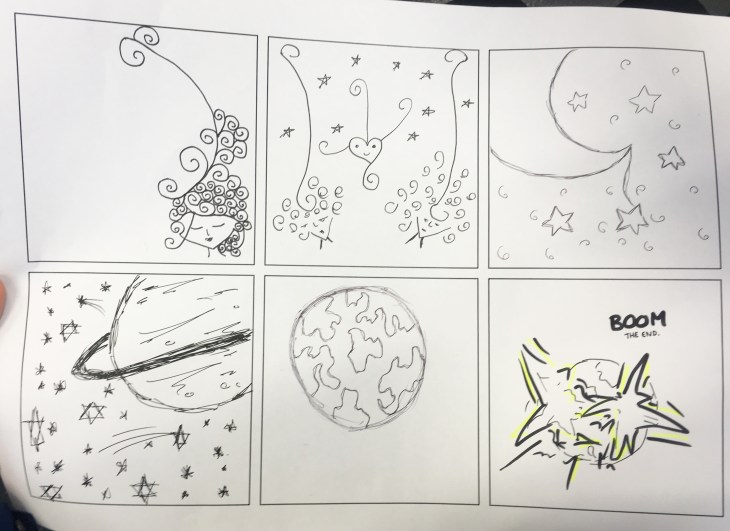
- Moment to moment: image when another moment becomes closer, the same moment different scene and closeness of the scene being portrayed.
- Action to action: action taking place, and on the second picture the action is carried to another.
- Subject to subject: one is an image of characters and the scenery changes.
- scene to scene: different placement/enviroment being shown on there different images. Text is necessary to clarify the scene of the next scene.
- Aspect to aspect: Moving to another aspect(what the audience should focus on) it is used to introduce characters or situations. Shows different side of the scene.
- Non sequitur: no specifically connection between the two images. No clear link but it still develops into a story.
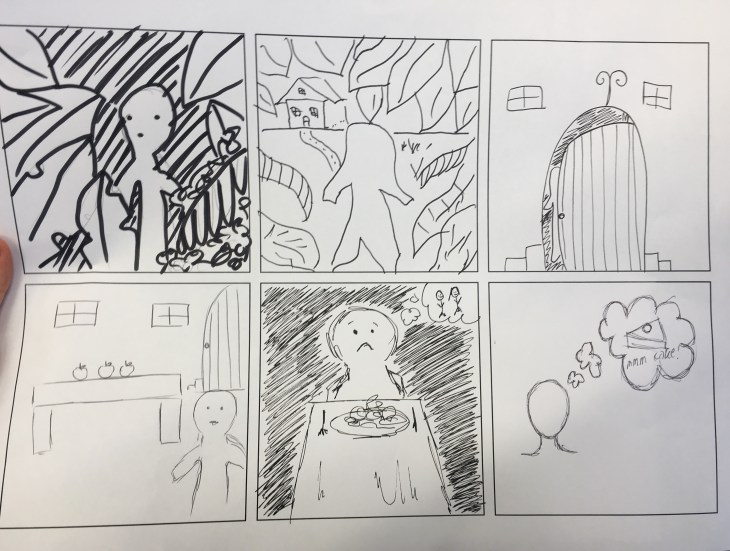
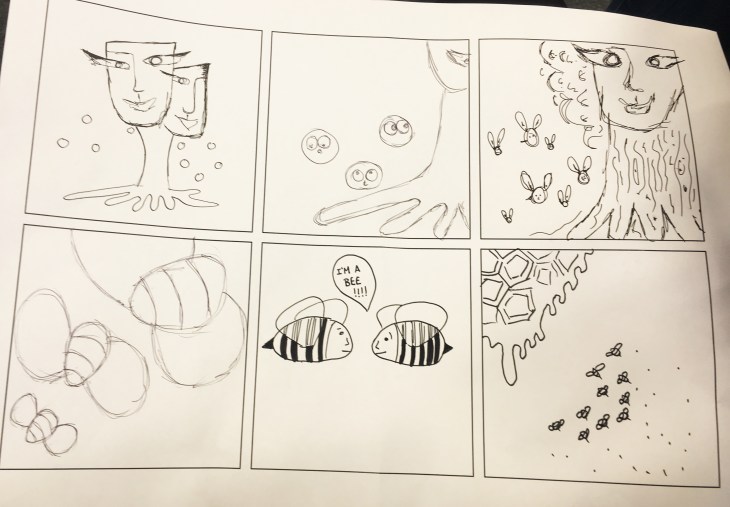
As a group of six people, we were give a paper sheet with six squares and had to draw something in 5min in the first square, and pass the sheet to another person so the story can be continued. It was really interesting to see how the stories were carried further, just by a simple drawing like a star or a weird creature. The way different people look at details is very personal as well.
“Happy Birthday Grandma!”: Stereotypes and Identity Politics
stereotypes and intersectionality. We discussed how stereotypes are formed, the effects they have, the difficulty of communication without stereotypes, and how they might be challenged. See below for some videos we discussed in class, along with readings on intersectionality, identity politics and stereotypes.
Dissecting the Visual : Keywords: Analysing Visual Qualitative Data, Critical Frameworks, Research Methodologies
Investigating the variety of ways in which visual research can be applied, consumed and analysed, this series will look at how to conduct a ‘pictorial autopsy’ and the importance of cumulative research. Whether creating practical work or using the ideas of others to support concepts, the whole is often greater than the sum of its parts. Dissecting the Visual will look at how to turn the scalpel on the picture, cutting, delving and probing in order to discover meaning and pattern. In a post mortem of pictorial analysis It will explore the ways imagery can be reviewed in a critical framework, shedding new light and offering fresh potential. Examining evidence, questioning details, testing theories and sharpening your tools can lead to exciting outcomes and ultimately, solve the mystery.

 Despite my deepest thoughts